
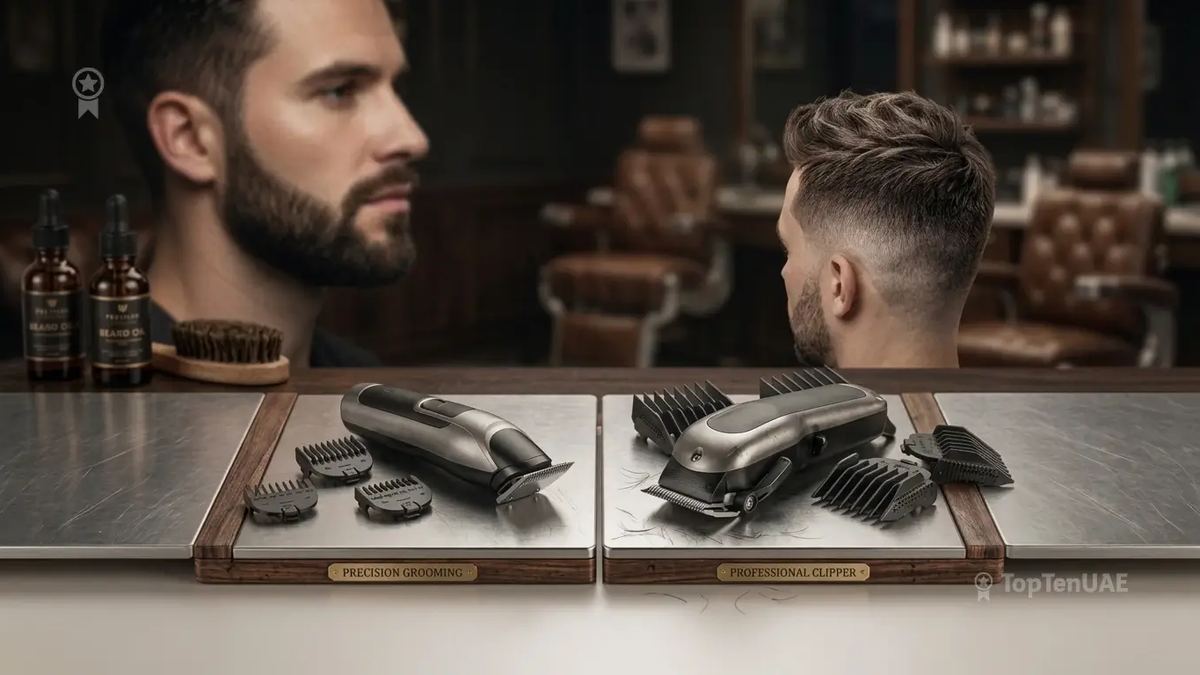
Beard trimmer vs hair clipper at a glance
| Feature | Beard trimmer | Hair clipper |
|---|---|---|
| Primary task | Facial-hair length and shape | Head-hair cutting and bulk removal |
| Typical cutting area | More compact for control | Broader for coverage |
| Main strength | Short-length precision and detailing | Speed over a larger area |
| Moustache and edges | Usually easier to position | Can feel bulky without a detail tool |
| Full haircut | Possible on supported multi-use models | Core use case |
| Head-hair fade | Possible with suitable combs | Usually the stronger starting point |
| Long beard | Use a long-range beard comb | Can remove bulk if beard use is supported |
| Body grooming | Only where explicitly supported | Not automatically supported |
| Best fit | Stubble, beard shaping and facial detail | Buzz cuts, fades and full-head maintenance |
Modern products blur these categories. Braun’s current UAE range, for example, separates dedicated beard trimmers and hair clippers while also selling all-in-one kits with beard, hair, fading, body and detail attachments.
What is the main difference?
The useful distinction is the primary job each tool is designed to make easier.
Beard trimmer: controls and shapes shorter facial hair around small, curved and visually defined areas.
Hair clipper: removes head-hair bulk and maintains haircut lengths over a much larger surface.
- Blade or cutting-head width.
- Guard design and usable range.
- Length increments and adjustment controls.
- Coverage, handling and visibility.
- Manufacturer-supported uses.
Why blade width and coverage matter
A broader clipper cutting area can remove more scalp hair per pass. That is useful for a full haircut, where speed and even coverage matter.
The same size can be awkward under the nose, near the lower lip, along a curved jaw or against a crisp cheek line. A compact trimmer head generally trades some coverage for positioning control.
Useful shorthand: clipper for coverage; trimmer for control. It is a starting point, not a definition that every product follows.
Can you use hair clippers on a beard?
Sometimes. A hair clipper can remove beard bulk when the manufacturer supports facial-hair use, the guard covers the intended length and the head is manageable around your face.
| Beard task | Clipper suitability |
|---|---|
| Remove bulk from a long dense beard | Potentially useful |
| Set one uniform longer length | Possible with the correct supported guard |
| Trim moustache corners | Usually less convenient |
| Define a cheek or neck line | A narrow detail head is generally easier |
| Maintain 1–3 mm stubble precisely | Beard trimmer is usually the better starting point |
The ability to cut beard hair does not prove that a clipper provides the short increments, visibility or detail control you need.
Can a beard trimmer cut head hair?
Some can, especially all-in-one models supplied with dedicated hair combs. Check the stated head-hair use, maximum length, guard design, cutting coverage and runtime.
- Dedicated hair combs are included.
- The range includes your haircut length.
- The blade and motor are intended for scalp hair.
- The cutting area is practical for a full head.
A beard-only trimmer may eventually cut an entire head yet still be a poor regular haircut tool because the head is narrow, the range is limited or the job takes too long.
Which is better for a full head haircut?
A dedicated hair clipper is usually the better starting point for regular full-head cutting, bulk removal and clipper-guard workflows.
Braun’s current UAE hair-clipper range illustrates the category: its HC7390 uses two dedicated combs covering 3–24 mm and 14–35 mm, with 17 settings. That substantially longer guarded range differs from beard-first precision around short facial lengths.
| Routine | Better starting point |
|---|---|
| Weekly buzz cut | Dedicated hair clipper |
| Regular full haircut | Dedicated hair clipper |
| Occasional tidy-up | Supported all-in-one may be enough |
| Only sideburn and hairline cleanup | Detail trimmer may be enough |
| Professional-style fading practice | Clipper plus appropriate taper or fade controls |
Beard trimmer vs clipper for a fade
A fade requires repeatable transitions between lengths. A dedicated clipper is normally the stronger primary tool for head-hair fades because the task depends on broad coverage, guard progression and controlled blending.
A beard trimmer can help with hairline, sideburn and small finishing areas. Some all-in-one systems add separate beard and hair fading combs; that is more meaningful than a generic “fade capable” label.
| Task | Useful tool |
|---|---|
| Remove head-hair bulk | Hair clipper |
| Blend main haircut lengths | Hair clipper and its guard/taper system |
| Clean the hairline | Detail trimmer |
| Blend sideburn into beard | Clipper plus beard/detail trimmer |
| Create a beard-only graduation | Beard trimmer with fine steps or beard fading comb |
Can a beard trimmer fade head hair?
Only when the exact model supports head hair and includes a usable range or fading attachments. Do not expect a beard-only 0.5–10 mm system to replace a clipper when your haircut requires broader or longer guards.
Which is better for a short beard?
A beard trimmer is usually the logical choice for 1–5 mm facial hair because fine short-range control, compact handling and access around the moustache and jaw matter more than scalp coverage.
| Target | What to prioritise |
|---|---|
| 1–3 mm stubble | Fine increments and secure short comb |
| 3–5 mm beard | Stable main beard comb and detail head |
| 6–10 mm beard | Longer-comb stability and even hair feed |
| 10–20 mm beard | Verified maximum guarded length and useful steps |
For millimetre ranges, fading combs and attachment functions, use our beard trimmer length and attachment guide.
What is better for a long beard?
Compare the actual guarded range rather than the product category. A long-range beard trimmer can reach 16–20 mm or more on selected models; a clipper may remove bulk but can be less convenient for facial detailing.
- Maximum guarded beard length.
- Increment size around your target.
- Long-comb rigidity and hair feed.
- Ability to work around the moustache and jaw.
- Whether scissors help with very long or isolated hairs.
Useful workflow: comb → remove bulk gradually → establish the guarded length → detail the boundaries.
Which tool is better around the face?
| Area | Better starting choice | Why |
|---|---|---|
| Moustache | Beard or detail trimmer | Compact control and visibility |
| Cheek line | Detail trimmer | Precise boundary positioning |
| Neckline | Beard or detail trimmer | Controlled work under the jaw |
| Sideburn bulk | Clipper | Connects to the haircut area |
| Sideburn finish | Detail trimmer | Refines the final boundary or transition |
| Long beard bulk | Supported clipper or long-range trimmer | Hair volume rather than fine line work |
Can either tool be used for body hair?
Do not assume so. A beard trimmer is primarily intended for facial hair and a hair clipper for scalp hair unless the manufacturer explicitly documents other areas and supplies the appropriate attachment.
For clearance, sensitive-area design and intended-use differences, read beard trimmer vs body groomer.
When an all-in-one trimmer can do both
An all-in-one can genuinely bridge beard and hair tasks when its documentation supports both and its package contains the right combs.
| Component | Why it matters |
|---|---|
| Beard combs | Short and medium facial-hair control |
| Hair combs | Head-hair lengths beyond the beard range |
| Hair fading combs | Gradual scalp transitions |
| Beard fading combs | Sideburn and beard-length blending |
| Detail head | Moustache, cheek, neck and hairline work |
| Mini foil head | Close finishing on small selected areas |
| Body attachment | Only for documented body-grooming use |
Braun’s current UAE all-in-one range lists configurations with sliding beard and hair combs, separate beard and hair fading combs, detail tools, a body head and a mini foil attachment. It also warns that some attachments may not be available in every country, so the exact UAE package still needs verification.
Philips’ current UAE MG7922/15 is another manufacturer example: it is explicitly positioned for face, hair and body, with a 0.5–16 mm multi-comb range and dedicated fixed hair combs. That does not mean every Philips or every “13-in-1” package has the same contents.
All-in-one vs separate clipper and trimmer
| Choose | When it makes sense | Trade-off |
|---|---|---|
| All-in-one | Occasional haircut plus regular beard and other grooming | More attachments; may be slower for full haircuts |
| Dedicated beard trimmer | Beard is the primary task | Does not necessarily cover full head-hair needs |
| Dedicated hair clipper | Frequent full haircuts, buzz cuts or fades | Less convenient for fine facial work |
| Separate clipper and trimmer | You regularly maintain both hair and a detailed beard | Higher cost and more storage |
The deciding question: how often do you cut your entire head? Occasional touch-ups favour versatility; frequent full cuts favour a dedicated clipper.
Do you need both tools?
You may not need a clipper when
- You get professional haircuts and only maintain your beard at home.
- You make only occasional hairline or sideburn adjustments.
- Your all-in-one explicitly supports your simple haircut and includes suitable guards.
Consider a clipper when
- You cut your whole head regularly.
- You remove substantial head-hair bulk.
- You need a long guard range or perform fades.
Add a beard trimmer when
- You maintain short stubble.
- You shape moustache corners, cheek lines or the neckline.
- You want fine facial-length adjustments.
Blade width is not the only comparison
| Check | Why it matters |
|---|---|
| Cutting range | The shortest and longest supported guarded lengths |
| Increment size | How precisely you can repeat a beard or fade length |
| Comb stability | Whether the selected height remains consistent |
| Cutting coverage | How efficiently each pass handles the target area |
| Intended use | Whether beard, head hair or both are documented |
| Detail capability | Whether a narrow blade or head supports small areas |
| Power arrangement | Runtime, corded support and full-session reliability |
| Maintenance | Cleaning, lubrication and replacement-part requirements |
What length range do you need?
| Goal | Starting range or requirement |
|---|---|
| Short stubble | 0.5–3 mm with fine control |
| Short beard | 3–5 mm with a stable comb |
| Medium beard | 6–10 mm with good hair feed |
| Long beard | 10–20 mm+ when actually worn |
| Short buzz cut | Hair guards matching the desired crop |
| Longer haircut | Head-hair guard range may need to extend well beyond beard settings |
A 20 mm beard range may suit many fuller beards, while some head-hair styles require substantially longer guards. Reaching 20 mm does not make every beard trimmer equally suitable for a full haircut.
Why attachment count can mislead
“15 attachments” does not tell you whether the tool is good at beard trimming, hair clipping or either. Translate the bundle into tasks.
- What exact beard lengths are covered?
- What exact head-hair lengths are covered?
- Are beard and hair fading combs different?
- Is there a useful detail head?
- Will you actually use body, nose or foil attachments?
- Can replacements be sourced by exact part number?
Power, corded use and runtime
Power matters for dense or longer hair, but motor claims should be considered with blade efficiency, hair capture, comb design and maintenance.
| Power arrangement | Advantage | Best fit |
|---|---|---|
| Corded | No mid-session battery limit | Long or frequent haircut sessions |
| Cordless | Easy movement around face and head | Beard grooming and convenient home cuts |
| Cordless with quick charge | Recovery from a low battery | Short trims; verify whether quick charge covers a full haircut |
For a full haircut, compare runtime with your actual session length. A quick beard trim and a careful 45-minute fade are different workloads.
Wet, dry and washable claims
A rinseable blade, washable heads and combs, a fully washable handle and shower use are not interchangeable. Check the exact model instructions.
| Claim | Verify |
|---|---|
| Washable blade or head | Whether it must be detached first |
| Washable device | Whether the full handle can go under the tap |
| Wet or shower use | Whether powered operation in water is supported |
| Cordless-only around water | Charging and operation restrictions |
Use our waterproof, washable and wet/dry guide before interpreting a water claim.
Cleaning a beard trimmer vs hair clipper
| Tool | Common areas to inspect |
|---|---|
| Beard trimmer | Precision blade, short comb, detail head and compact hair buildup |
| Hair clipper | Broader blade, large guards, dense hair buildup and blade alignment |
| All-in-one | Every used head plus the attachment joints and storage system |
- Switch off and disconnect the tool as instructed.
- Remove hair from the blade and guard using the permitted method.
- Rinse only components approved for water cleaning.
- Dry components as instructed before storage or charging.
- Lubricate only when and with what the manufacturer specifies.
Washability and lubrication are separate questions. Philips says the MG7922/15 uses self-sharpening blades with no oil required, while many other clipper systems specify oiling.
Troubleshooting before buying another tool
If the clipper pulls hair
- Clean and inspect the blade.
- Check lubrication requirements and guard installation.
- Verify battery level or corded power.
- Reduce the hair length gradually when removing substantial bulk.
If the beard trimmer misses hair
- Check whether the beard is too long for the selected comb.
- Comb flat-lying or multi-directional hair before another pass.
- Keep the comb seated consistently and slow down.
- Inspect for a dirty, worn or incorrectly fitted head.
A stronger motor does not automatically solve a guard, range or technique mismatch.
Which tool is better for each DIY grooming task?
| Task | Best starting choice |
|---|---|
| 1–3 mm stubble | Beard trimmer |
| 3–10 mm beard | Beard trimmer |
| 10–20 mm beard | Long-range beard trimmer |
| Moustache and neckline | Beard or detail trimmer |
| Remove substantial head hair | Hair clipper |
| Regular buzz cut | Hair clipper |
| Head-hair fade | Hair clipper |
| Beard fade | Trimmer with fine or fading controls |
| Occasional hair plus beard | Documented all-in-one |
| Body grooming | Dedicated body groomer or explicitly supported multifunction tool |
Hair clipper vs beard trimmer for sensitive skin
Neither category automatically wins. Prioritise an appropriate guard, good control, light pressure, a clean maintained cutting system and efficient passes. A poorly maintained beard trimmer can be uncomfortable, just as an oversized clipper can be awkward on facial contours.
Persistent painful bumps, broken skin or ongoing irritation should not be treated only as a tool-selection problem.
What UAE buyers should verify
Exact model and package
- Manufacturer-supported beard, hair and body uses.
- Included UAE combs and attachments rather than global promotional photos.
- Shortest, longest and incremental settings for each task.
Power and water
- Runtime, charge time, corded use and quick-charge limits.
- UAE plug, adapter, USB and voltage requirements.
- Exactly which components can be rinsed or used wet.
Ownership
- Replacement blade, guard and head availability.
- Local warranty, seller and return terms.
- Storage space for every attachment you will use.
How to read an Amazon.ae listing
A title saying “beard + hair + body” is not enough. Confirm beard range, hair range, proper hair combs, any fading tools, detail capability, charger contents, water permissions and UAE warranty.
A 60-second decision guide
| Question | If yes |
|---|---|
| Is beard grooming your main task? | Choose a beard trimmer |
| Do you regularly cut your full head? | Choose a hair clipper |
| Do you maintain both beard and simple short hair? | Compare a documented all-in-one |
| Do you wear 1–5 mm facial hair? | Prioritise beard-trimmer precision |
| Do you wear a 10–20 mm beard? | Compare long-range beard trimmers |
| Do you need crisp moustache and cheek lines? | Require a compact detail tool |
| Do you perform head-hair fades? | Start with a dedicated clipper |
| Are haircuts occasional but beard trims frequent? | All-in-one may offer better convenience |
| Will you never use body or nose attachments? | Do not pay heavily for them |
Three real-world buying scenarios
| Routine | Best starting purchase | Priority |
|---|---|---|
| 3 mm beard; barber cuts your hair | Beard trimmer | Fine increments, secure comb, detail head |
| DIY haircut every two weeks; 5 mm beard | All-in-one or separate clipper and trimmer | Hair guards, coverage and facial detail |
| 15 mm beard; occasional hair touch-up | Long-range beard trimmer or documented all-in-one | Stable long comb plus genuine hair support |
A beard trimmer reaching 20 mm is not automatically a good haircut clipper. Head-hair range, guard shape and cutting coverage still need to match the job.
Common myths
| Myth | More accurate answer |
|---|---|
| A clipper is just a bigger beard trimmer | The categories overlap but prioritise different tasks and guard systems |
| A beard trimmer cannot cut head hair | Some multifunction models explicitly support both |
| A hair clipper cannot cut a beard | Some can remove beard bulk when that use is supported |
| More attachments means better | Only useful attachments add value |
| A 20 mm trimmer is better than a 10 mm model | Only when you need the extra range |
| More power solves every problem | Blade, guard, range, maintenance and technique also matter |
Final verdict
Choose a beard trimmer when: you want facial-hair length control, short stubble, beard shaping or detailed edges.
Choose a hair clipper when: you want efficient head-hair bulk removal, haircut lengths, buzz cuts or fades.
Choose an all-in-one when: you genuinely perform both tasks and the exact package provides suitable ranges, hair combs and detail tools.
Buy separate tools when: you regularly cut your full head and also maintain a detailed beard.
Do not choose by category name or attachment count alone. Match the exact blade, coverage, guard system, range and manufacturer-supported uses to your actual routine.
For beard-first products, compare our best beard trimmers in UAE. Then use the length and attachment guide to define the range you need.
How we research this guide
This is a research-based consumer guide, not a laboratory test. We compare current manufacturer specifications, supported attachments, manuals, replacement-part information and UAE-market packages. We do not independently measure cutting speed, haircut quality, blade durability, runtime or long-term reliability. Manufacturer performance claims are attributed rather than presented as independent guarantees.
Sources
- Braun UAE: current stylers and trimmers(opens in a new tab) — category ranges, beard, all-in-one and hair-clipper configurations; checked 2026-09-09.
- Braun UAE: current hair clippers(opens in a new tab) — dedicated head-hair range, guards and cutting use; checked 2026-09-09.
- Braun UAE: Hair Clipper Series 7 HC7390(opens in a new tab) — model-specific settings, runtime, cleaning and package; checked 2026-09-09.
- Braun UAE: all-in-one trimmer range(opens in a new tab) — beard, hair, fading, body and detail attachment examples; checked 2026-09-09.
- Braun UAE: Beard Trimmer 9 and All-in-One Trimmer 9 support(opens in a new tab) — comb, fading, detail and replacement-part codes; checked 2026-09-09.
- Philips UAE: All-in-One Trimmer 7000 MG7922/15(opens in a new tab) — face, hair and body use, comb ranges, attachments, runtime and maintenance; checked 2026-09-09.