
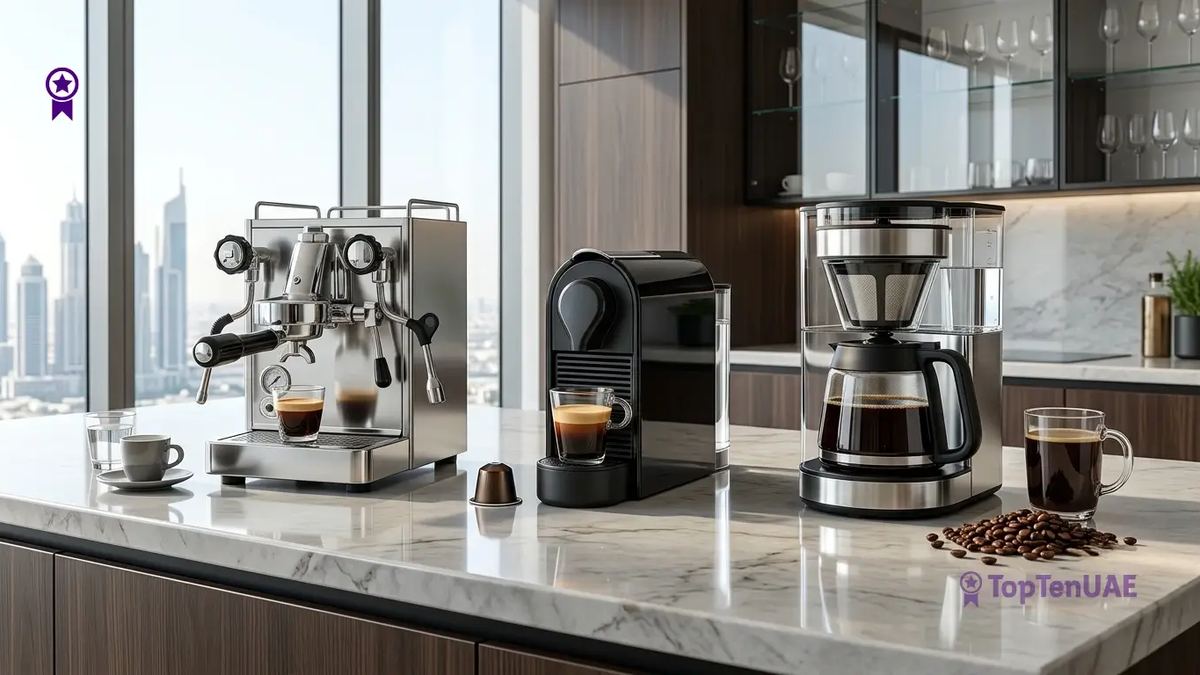
Four formats, four different jobs
| Format | How it works | Best fit | Main trade-off |
|---|---|---|---|
| Manual espresso | Pressure pushes hot water through a prepared portafilter | Control and hands-on espresso/milk drinks | Technique, grinder and cleanup |
| Capsule | A sealed single portion is pierced and brewed | Fast, repeatable single cups | System compatibility, pod cost and packaging |
| Filter | Water passes through ground coffee into a jug/carafe | Several long coffees at once | No true espresso or built-in milk texturing |
| Bean-to-cup | Internal grinder doses and an automatic brew group extracts | Fresh-bean cups with fewer manual steps | Footprint, mechanical complexity and maintenance |
Bean-to-cup belongs in the main comparison because it solves a distinct problem: it combines a grinder with automated individual brewing. It is not merely a premium manual espresso machine and should not be treated as a footnote.
What coffee does each make?
Manual espresso and many bean-to-cup machines make concentrated espresso-style drinks. Capsule output depends on the capsule family and programmed sizes. Filter machines make longer, lower-pressure brewed coffee. An Americano made from espresso is not the same brewing method as filter coffee, even if the final cup size is similar.
Milk drinks
- Manual espresso: a steam wand can provide the most direct texture control, with practice and immediate cleaning.
- Capsule: many compact machines have no milk system; add a separate frother or choose a specific milk model.
- Filter: add milk separately; the brewer itself normally does not texture milk.
- Bean-to-cup: a steam wand or automatic carafe may be included, depending on model.
Compare the hygiene, control and replacement-part implications in our milk-system guide.
Convenience, speed and learning curve
| Question | Manual espresso | Capsule | Filter | Bean-to-cup |
|---|---|---|---|---|
| Preparation | Grind/dose/tamp | Insert capsule | Dose grounds and water | Refill beans/water; choose drink |
| Learning curve | Highest | Lowest | Low | Low for drinks; medium for settings/care |
| One cup | Fast after setup and dial-in | Usually fastest workflow | Possible but not its strongest use | Convenient individual cup |
| Several cups | Sequential shots | Sequential capsules | Best natural batch format | Sequential cups; capacity matters |
| Cleanup | Portafilter and milk work | Tray/bin/outlet | Filter/grounds/jug | Rinses, puck bin, brew group and milk path |
Published heat-up claims vary by model and test conditions. A fast warm-up does not include time spent grinding, steaming, emptying a bin or waiting for a second drink, so compare the complete routine.
Freshness and control
Whole beans ground immediately before brewing can preserve volatile aromas better than coffee ground long in advance, but bean age, storage, grinder quality and recipe still matter. Capsules protect a fixed portion; filter and manual espresso allow broad coffee choice. Taste preference is personal, not a universal format ranking.
Manual espresso provides the most direct control over grind, dose, distribution, yield and milk texture. Bean-to-cup usually exposes strength, volume and grind settings within a narrower automated system. Capsule control is mainly capsule choice and programmed volume; filter control comes from coffee-to-water ratio, grind, temperature and contact time.
If grinder capability is part of that decision, see whether you need a coffee grinder.
Upfront and recurring cost
A capsule machine can have a low entry price but a higher coffee cost per serving at some consumption levels. Manual and filter setups may require a grinder; bean-to-cup includes one but adds filters, cleaning products and more serviceable parts. Coffee quality and quantity can reverse simple comparisons.
Use the neutral cost-per-cup calculator and ownership checklist rather than assuming one format is always cheapest.
Waste and packaging
Capsules create a separate portion package; beans and ground coffee use larger bags but produce loose grounds. Recycling options, material separation and local collection differ. Compare the whole routine—packaging, wasted stale coffee, paper filters, milk and cleaning consumables—not one item in isolation.
Water, footprint and shared use
- Small kitchen: a narrow capsule machine can be easiest, but add space for pods and any milk frother. Some slim manual machines still need a grinder.
- Shared household: bean-to-cup reduces technique differences; filter serves a group; capsule prevents recipe disagreements but creates repeated single portions.
- Office: decide whether the priority is a shared batch or on-demand drinks, then assign refilling and cleaning responsibility.
- Travel or relocation: loose appliances must match destination voltage, plug, capsule supply and warranty region. Do not assume a travel adaptor solves a voltage mismatch.
Plan actual access and operating clearance with the coffee maker size guide for UAE kitchens.
Choose manual espresso if…
- You want to learn and adjust extraction and milk texture.
- You will budget for a suitable grinder or accept pre-ground limitations.
- You do not mind rinsing the portafilter and cleaning the steam wand after use.
Read the manual vs automatic espresso comparison for the exact workflow boundary.
Choose capsule if…
- Your priority is fast, repeatable, individual cups with little preparation.
- The exact capsule family and your preferred coffees are reliably available in the UAE.
- You accept per-capsule purchasing and system-specific waste handling.
Avoid compatibility mistakes with the UAE capsule-system guide.
Choose filter if…
- You want a jug of long coffee for several mugs or people.
- You prefer a simple brewer and can buy suitable ground coffee or add a grinder.
- Espresso pressure and automatic milk drinks are not priorities.
Choose bean-to-cup if…
- You want fresh-ground individual drinks without manual dosing or tamping.
- You have room for a deeper machine and will maintain the brew group, puck bin and milk system.
- Multiple users value repeatable controls more than maximum manual control.
For the closest two-format decision, read bean-to-cup vs capsule.
Fast answers to the common comparisons
| Priority | Likely starting point | Important condition |
|---|---|---|
| Cheapest to run | Filter, manual or bean-to-cup may win | Depends on coffee dose/price, waste and consumables |
| Easiest maintenance | Basic capsule or filter | Milk systems can change the answer |
| Most control | Manual espresso | Requires grinder skill and repetition |
| Fastest single-cup workflow | Capsule | Model heat-up and drink size vary |
| Several cups | Filter | Automatic machines still serve cups sequentially |
| Milk drinks | Manual steam or automatic carafe | Choose control versus cleaning convenience |
| Small UAE kitchen | Compact capsule or narrow manual | Include pod/grinder/frother and access space |
UAE purchase checks
Confirm 220–240V, the Type-G plug, exact model suffix, seller, local warranty and authorised support. For capsules, check the exact system on Nespresso UAE or the relevant manufacturer; for beans and grounds, check your preferred roast and grind are obtainable consistently.
For a specification-by-specification process, return to how to choose a coffee maker.
Final recommendation
Choose the format whose complete daily routine fits: preparation, cup style, group size, milk work, cleanup, replenishment and long-term cost. Do not use taste, pressure or purchase price as a one-number verdict.
Then compare the six differentiated current picks in Best Coffee Makers in UAE.