
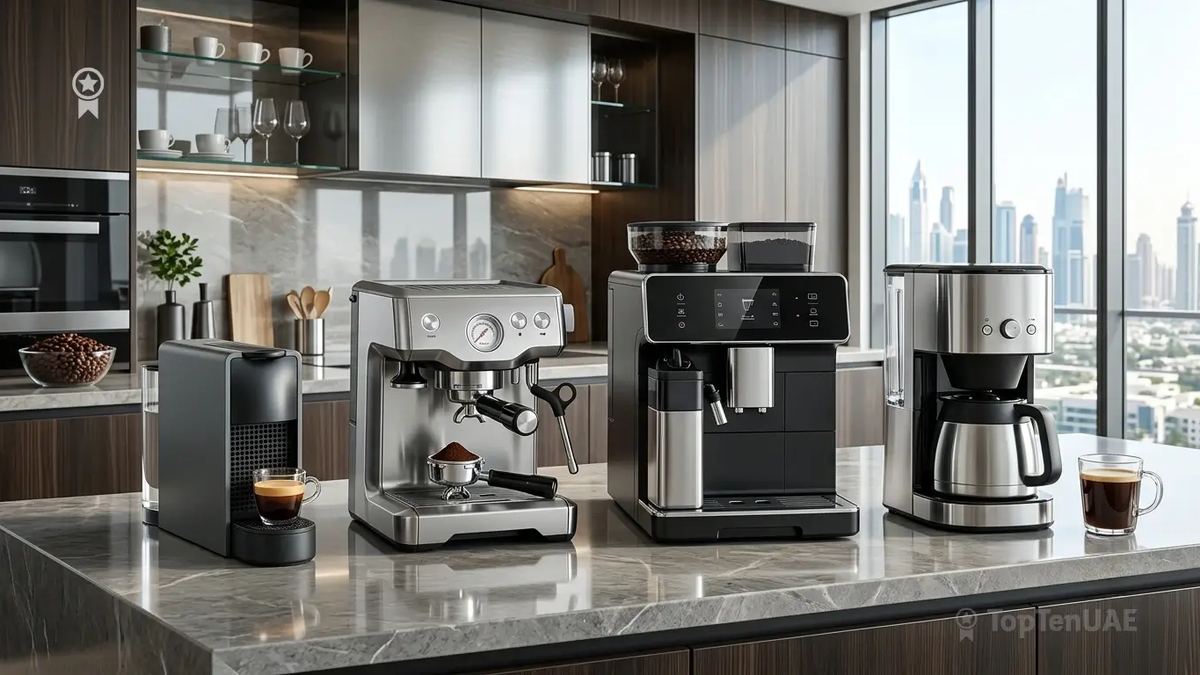
1. Begin with the coffee you actually drink
| Usual drink | Format to investigate first | Main compromise |
|---|---|---|
| Short espresso or lungo with minimum effort | Capsule | Locked or limited capsule compatibility and recurring pod cost |
| Several mugs of long black coffee | Filter/drip | No true espresso or integrated milk texture |
| Espresso with hands-on control | Manual or semi-automatic espresso | Grinder, technique and cleanup |
| Fresh-bean coffee at one touch | Bean-to-cup/fully automatic | Larger footprint and more internal maintenance |
| Mostly latte or cappuccino | Espresso format plus a suitable milk system | Milk hygiene and cleaning workload |
Espresso is a concentrated extraction; a lungo sends more water through a similar coffee format; long coffee may mean an automatic machine recipe, an Americano, or filter coffee. Those cups are not interchangeable, so write down your normal drink size, strength and milk use before comparing machines.
If the four formats are still unclear, use the espresso, capsule, filter and bean-to-cup comparison before looking at specifications.
2. Choose the amount of automation
Capsule
The machine meters a single sealed capsule and is usually quick to learn. Check the exact capsule family, local supply, drink sizes, used-capsule capacity and whether milk requires a separate frother. Never assume two similarly shaped systems are compatible.
Filter
A filter machine is the natural batch option: water passes through ground coffee into a jug or thermal carafe. Check brew capacity, minimum practical batch, hotplate or thermal-carafe design, auto-off, filter type and whether you need a grinder.
Manual or semi-automatic espresso
You load a portafilter, control preparation and usually steam milk manually. “Automatic” can mean volumetric shot stopping without automatic grinding, dosing or tamping, so read what the machine actually automates.
Our manual vs automatic espresso guide untangles those labels and workflows.
Bean-to-cup
A bean-to-cup machine grinds beans internally, doses and brews with little manual preparation. Models differ sharply: some make black coffee and provide a steam wand; others add one-touch milk recipes and a detachable carafe. Convenience shifts work from preparation to refilling, rinsing and periodic internal care.
Compare that fresh-bean workflow directly with pod simplicity in the bean-to-cup vs capsule guide.
3. Decide whether you need a grinder
Capsule machines do not need one. Filter brewers and manual espresso machines can use pre-ground coffee, but fresh whole beans require a grinder. Espresso is particularly sensitive to grind size and consistency; a blade chopper does not provide the controlled, repeatable grind of a burr grinder.
An integrated grinder saves one purchase and can reduce the spread of the setup. A separate grinder can offer easier upgrades, repair separation and movement between brew methods, but it consumes another socket and more counter space.
Use the coffee grinder decision guide to match grind capability to espresso or filter brewing.
4. Pick a milk workflow you will actually clean
| Milk setup | Control | Convenience | Cleaning implication |
|---|---|---|---|
| None | No milk texture | Simplest | No milk path |
| Separate frother | Low to medium | Easy to add to any coffee | Separate vessel or whisk to wash |
| Steam wand | Highest manual control | Technique required | Purge and wipe immediately after use |
| Automatic carafe/tube | Recipe settings vary | One-touch drinks | Rinse cycle plus tube/carafe disassembly and chilled storage as directed |
Frequent lattes may justify an automatic carafe; an occasional cappuccino may not. Check which parts detach, which can enter a dishwasher, how milk is stored, and whether tubes, seals and carafes are sold locally.
See the practical cleaning and control trade-offs in our coffee machine milk-system guide.
5. Measure capacity and access—not just litres
- Water tank: estimate drinks between refills, then check whether it lifts up, slides forward or pulls out behind the machine.
- Bean hopper: larger is not automatically better; beans left warm and exposed age. Match it to normal use.
- Drip tray and puck/capsule bin: small capacities add interruptions in a shared household or office.
- Height and overhead clearance: top-loading beans, capsules and rear tanks need room beneath cabinets.
- Depth: include the plug, cable bend, ventilation and the reach needed to remove tanks, trays and portafilters.
Measure the operating envelope with the coffee maker size and counter-space checklist.
6. Compare controls that change daily use
One-touch drink buttons reduce steps; manual controls let you change dose, grind, yield and milk texture. Programmability may mean only a cup volume, or it may include strength, temperature, profiles and milk ratios. Verify what is saved, how many profiles exist and whether guests can use the controls easily.
Heat-up and noise matter most when several people use the machine early or in a small apartment. Use manufacturer figures only when stated for the exact model; grinder noise and pump sound are rarely comparable across marketing pages.
7. Price the ownership, not only the machine
Recurring costs can include capsules or beans, paper filters, milk, descaler, water filters, cleaning tablets, milk cleaner, seals and replacement carafes. A lower purchase price can still lead to a higher cost per drink at your consumption level.
Calculate your own routine with our coffee machine cost-per-cup formula.
8. Treat maintenance as a buying specification
Check what must be cleaned after every milk drink, daily, weekly and when prompted. Ask whether the brew group is removable, whether the machine requires a filter, what descaler is approved, and whether replacement filters and seals are available in the UAE.
The complete cleaning and descaling guide shows the workload by machine type.
9. UAE checkout checklist
- Confirm 220–240V and the frequency shown for the exact regional model; a plug adaptor does not change voltage.
- Confirm a UAE Type-G plug on the exact seller offer and use a suitable wall socket.
- Match the full model suffix, not only the family name; global variants can differ in power, accessories and warranty.
- Verify the seller, written local-warranty coverage, invoice requirements and authorised UAE service route.
- Check local supply of the exact capsule family, filters, descaler, cleaning products, milk parts and seals.
Which coffee maker is right for me?
- Need several mugs together? Start with filter. Otherwise continue.
- Want the least preparation and no fresh-bean requirement? Start with capsule.
- Want fresh beans with one-touch brewing? Start with bean-to-cup.
- Want to learn grind, dose, tamp and milk texture? Start with manual espresso and budget for a capable grinder.
- For any milk-drink choice, select the cleaning routine before the milk feature.
Real buyer scenarios
| Buyer | Strong starting point | Check before buying |
|---|---|---|
| One espresso drinker | Compact capsule or narrow manual espresso | Capsule lock-in versus grinder/technique |
| Couple | Capsule, manual espresso or compact bean-to-cup | Back-to-back speed and shared preferences |
| Family/shared kitchen | Bean-to-cup or filter | Tank, waste-bin and milk cleaning capacity |
| Office | Filter for a shared jug; automatic for on-demand cups | Throughput, refills, cleaning ownership and support |
| Latte/cappuccino user | Espresso format with steam wand or carafe | Milk hygiene and texture control |
| Beginner/low maintenance | Capsule or simple filter | Consumable availability and recurring cost |
| Enthusiast | Manual espresso plus burr grinder | Learning time, dial-in waste and counter space |
| Small kitchen | Narrow capsule or manual machine | Depth, top/rear access and separate grinder/frother |
Common buying mistakes
- Choosing by bar pressure, wattage or drink-button count alone.
- Measuring body width but forgetting depth, open access and overhead clearance.
- Assuming an automatic milk drink means automatic cleaning.
- Buying an imported voltage or capsule variant because the family name looks familiar.
- Ignoring who will empty, rinse, refill and descale the machine in a shared space.
Final recommendation
Choose the simplest format that reliably makes your normal drinks at your normal volume. Resolve grinder, milk, space, maintenance, consumables and regional support before paying for extra recipes or controls.
Once you know the format and specifications you need, compare the current UAE models in our Best Coffee Makers in UAE buyer’s guide.