
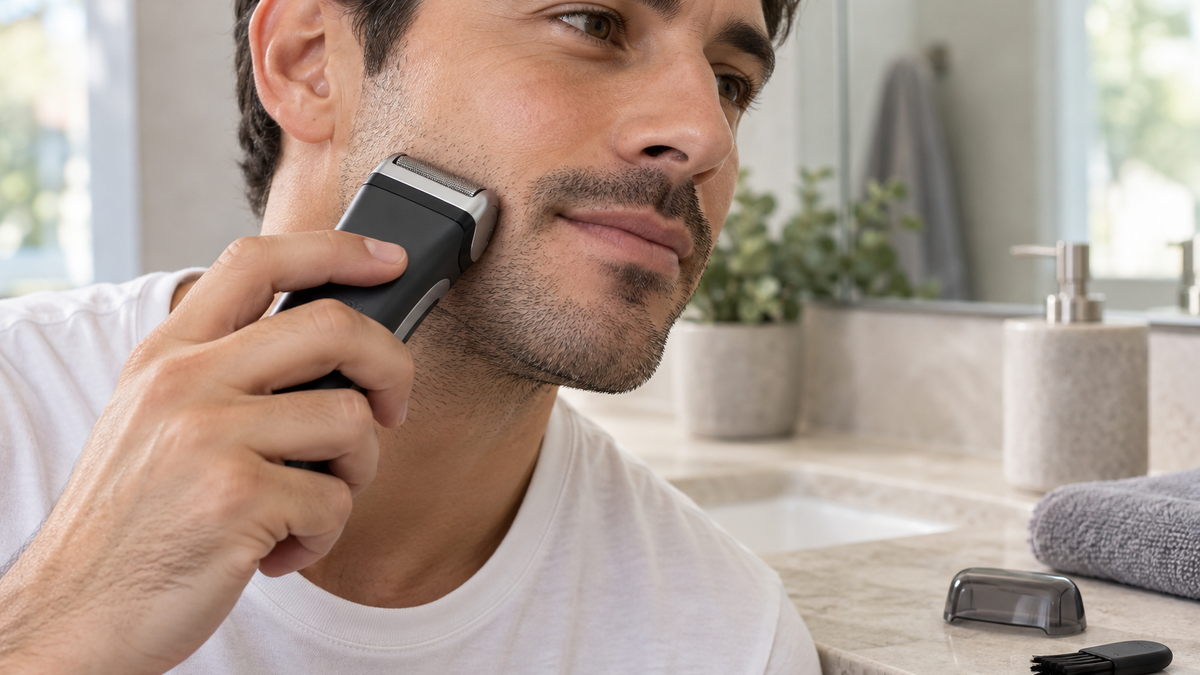
What should you look for in a sensitive-skin shaver?
No single specification makes a shaver medically safe for sensitive skin. Compare several practical characteristics and treat comfort language as a manufacturer claim rather than a guarantee.
| Feature | Why it can matter | What to verify |
|---|---|---|
| Foil or rotary head | Changes how the head contacts and captures hair | Which movement suits your face and growth pattern |
| Flexible head or foils | May maintain contact without extra pressure | How the exact mechanism moves and locks |
| Efficient hair capture | Fewer passes can mean less avoidable friction | Supported stubble length and difficult-hair handling |
| Pressure feedback or gentle mode | Can help identify excessive force | What feedback the exact model provides; it is not medical protection |
| Wet/dry support | Gives you another preparation method | Whether foam, gel and shower use are explicitly permitted |
| Replaceable cutting system | Worn parts can tug and encourage more passes | Part code, interval, price and UAE availability |
| Easy cleaning | Hair and residue can reduce consistent performance | The exact cleaning method and frequency |
| Battery and runtime | Low power can interrupt or rush a shave | Runtime, charge time and cordless restrictions |
Foil vs rotary: which is better for sensitive skin?
Foil shaver
A foil shaver uses perforated foils over oscillating cutters and is normally guided in straight or back-and-forth passes according to the model instructions. It can appeal to buyers who prefer defined passes, edge control and a predictable head orientation.
Rotary shaver
A rotary system uses circular cutting heads and is commonly guided in small circular movements. It may be useful around jaw and neck contours or where hair grows in several directions. Philips currently advises light pressure, slow circular movement and avoiding repeated passes for its rotary shavers.
The useful question: which system removes your normal growth efficiently without making you repeatedly cover one area or press hard? Neither head type automatically wins for every sensitive-skin user.
| Face area or need | Foil starting point | Rotary starting point |
|---|---|---|
| Cheeks | Controlled linear passes | Circular coverage |
| Jawline and chin | Works with careful angle and flexible foils | Contour following can suit curves |
| Neck | May need direction mapping and head-angle changes | May capture multi-directional growth efficiently for some users |
| Sideburns and defined edges | Often more direct | Usually needs a separate precision trimmer |
| Sensitive skin | Can be comfortable | Can be comfortable |
For the underlying head mechanics, see our foil vs rotary electric-shaver guide.
The biggest mistake: pressing too hard
More pressure does not reliably produce a better electric shave. Philips recommends light pressure and letting the shaver do the work; it also warns that repeated passes can increase friction and irritation.
Use enough contact for the cutting system to capture hair without forcing the head into the skin. If missed hairs make you press harder, check the likely cause instead:
- Worn or damaged foil, cutter or rotary head.
- Hair longer than the shaver captures efficiently.
- Incorrect angle or movement for the head type.
- Hair growing in an unexpected direction.
- A dirty head, low battery or unsuitable preparation method.
Prepare your skin and hair before shaving
Preparation should match both your skin needs and the exact wet/dry instructions. The American Academy of Dermatology advises softening hair with water, shaving after a shower where appropriate, and using suitable shaving cream or gel when addressing razor-bump risk. Do not add water or shaving products to a dry-only electric shaver.
- Clean the face gently and avoid shaving over visibly injured skin.
- For a wet-supported routine, soften the hair and use only products permitted by the shaver manufacturer.
- For dry shaving, follow the manufacturer’s dry-skin preparation instructions.
- Inspect the head and confirm that the battery has enough charge.
- Start with light pressure instead of chasing maximum closeness immediately.
Dry vs wet shaving for sensitive skin
Is wet shaving automatically better?
No. Wet shaving with foam or gel is another technique option, not a guarantee. Philips says it can provide additional comfort on compatible shavers, while still emphasising light pressure and fewer repeated passes. Individual results differ.
| Method | Potential reason to choose it | What to verify |
|---|---|---|
| Dry shaving | Fast routine without water or product residue | Dry-preparation and movement instructions |
| Wet shaving with foam or gel | May improve glide or comfort for some users | Exact product and shaver compatibility |
| Shower shaving | Convenience and softened hair | Explicit shower permission and cordless use |
Use our waterproof, washable and wet/dry shaver guide before interpreting a water claim.
How to shave sensitive skin with an electric shaver
1. Check the shaver
Inspect the foil or rotary head, cutter condition, cleanliness, charge level and the correct attachment. Panasonic warns against using a shaver with a damaged outer foil because the foil can cut the skin.
2. Prepare according to the shaving mode
Use only the dry or wet method supported by the exact model. If using foam or gel, confirm the manufacturer permits it.
3. Start with light pressure
Let the cutting system work. Do not force the head into the skin to chase a closer result.
4. Use the manufacturer’s movement
Foil and rotary systems use different movements. Philips recommends slow circular movement for its rotary heads; foil manufacturers may specify straight or back-and-forth passes.
5. Do not repeatedly attack one patch
If hair remains, reassess growth direction, angle, hair length and cutter condition. More passes add friction without guaranteeing better capture.
6. Clean, dry and store correctly
Follow the exact cleaning method, allow water-exposed parts to dry as directed, and protect thin foils from knocks.
Which direction should you shave?
For razor-bump prevention, the AAD advises shaving in the direction hair grows. Electric-shaver makers may specify a model-specific motion, such as circular movement for rotary heads. These statements are not contradictory: map your growth direction, then use the head movement and technique prescribed for the exact appliance.
Do not blindly apply one “against the grain” rule to every shaver. Around the neck, jaw and chin, hair often changes direction, so the angle or movement may need to change without adding pressure.
Should you pre-trim longer beard hair?
Yes when growth is longer than the shaving head captures efficiently. Pre-trimming can be especially useful after infrequent shaving, with heavy growth, or when repeated close-shaver passes are otherwise necessary.
Practical sequence: trim long growth first, then shave closer with the clean, intact head.
Does pressure feedback make a shaver better?
It can be a useful technique aid, but it is not a medical safeguard. Current Braun UAE Series 6 documentation describes flexible contour adaptation, a Sensitive Skin Guard and a Gentle mode as comfort-focused design features. Treat these as manufacturer claims to compare—not proof that a user will avoid razor burn, bumps, folliculitis or another reaction.
What does a flexible shaver head do?
A flexible head can maintain contact as the jaw, chin and neck surface changes, potentially reducing the temptation to force a fixed head into contours. “360-degree flexibility” or another marketing label does not automatically make one model best for sensitive skin; compare the mechanism, control and lock settings.
Why replacement foils and cutters matter
A worn or damaged cutting system can miss, pull or tug hair, encouraging harder pressure and more passes. Before buying, identify the genuine replacement head, foil or cutter, its manufacturer interval, price and UAE availability.
- Replace immediately if the foil or cutter is visibly damaged.
- Consider replacement when performance drops or pulling begins.
- Use the exact model’s interval; there is no universal schedule.
- Confirm the regional part code rather than buying by series name alone.
How often should you clean an electric shaver?
Follow the manufacturer first; some models call for cleaning after every use or after wet shaving. As part of its razor-bump guidance, the AAD advises cleaning an electric razor every five to seven shaves. That general interval does not override a stricter model-specific procedure.
Remove clipped hair, skin debris and shaving-product residue using only the permitted brush, water, cleaning station, fluid or lubricant. “Washable” does not mean every handle, attachment or charger can be rinsed.
Can you use shaving foam or gel?
Only with an exact model that supports wet shaving and the specific product type. Do not infer foam or gel compatibility from a generic waterproof claim. Charging equipment stays dry, and wet use is normally cordless according to the manufacturer instructions.
Should you choose a waterproof shaver?
Not solely because your skin is sensitive. Water protection is useful for wet shaving, rinsing or shower use when documented. It does not inherently make the cutting system gentler. A well-matched dry shaver with good technique may be more comfortable for one person than a wet/dry model.
Sensitive skin: what features deserve your money?
High-priority features
- Efficient capture of your usual beard length, reducing repeated passes.
- Good head control around your face and neck.
- Genuine replacement parts available at an acceptable cost.
- A cleaning method you will realistically maintain.
- Wet/dry capability only if it fits your preferred routine.
Claims not to overvalue
- “Skin-friendly” without a defined mechanism or model evidence.
- “Premium” as a substitute for fit, technique or replacement support.
- “AI shaving” without a clear buyer benefit.
- Any promise of “100% irritation-free” shaving.
Choose features around your shaving habits
| Your situation | What to prioritise |
|---|---|
| Daily shaving | Efficient head, light-pressure technique and easy cleaning |
| Every two or three days | Comfortable movement and multi-length hair capture |
| Weekly shaving | Longer-stubble handling or pre-trimming |
| Heavy or coarse beard | Efficient cutting system and adequate power |
| Hair grows in several directions | Growth mapping and a controllable contour-following head |
| Razor-bump prone | Technique, avoiding excessive closeness and professional advice if persistent |
| Prefer foam or shower use | Verified wet/dry and shower support |
| Travel frequently | Runtime, charging, protective case and replacement availability |
Sensitive skin, razor burn, razor bumps and folliculitis differ
These terms are not interchangeable. Immediate stinging or redness may have different causes from hairs curving back into the skin, while inflamed or infected follicles can require clinical assessment. This guide cannot diagnose the cause.
| What you notice | Practical response |
|---|---|
| Stinging or redness after shaving | Reduce pressure and passes, review preparation and stop on visibly irritated skin |
| Repeated small bumps after shaving | Map growth direction and review razor-bump guidance |
| Painful, inflamed, draining or persistent bumps | Stop treating it only as a product-selection issue and seek professional assessment |
| Bleeding, persistent rash or skin damage | Stop shaving the affected area and seek appropriate medical advice |
If you get razor bumps, change technique before upgrading
AAD guidance for razor-bump-prone shaving includes softening the hair, using an appropriate shaving product, shaving with the direction of growth, avoiding excessive pressure, limiting repeated passes, cleaning an electric razor and storing it dry. Apply that guidance alongside—not instead of—the electric shaver’s instructions.
Useful sequence: soften and prepare where supported → use light pressure → make controlled passes → clean the shaver → dry and store it correctly.
No electric shaver can guarantee prevention of razor bumps or ingrown hairs. The AAD recommends seeing a board-certified dermatologist when razor bumps continue despite changing shaving habits.
Should you shave every day or less often?
There is no universal schedule. For people specifically prone to razor bumps, the AAD notes that daily shaving or shaving at least every two to three days may leave less time for hairs to curve back into the skin. That does not mean everyone with sensitive skin should shave daily; hair growth, skin response and clinician advice matter.
What if a new electric shaver irritates you?
- Reduce pressure. Do not force a new head to behave like the old one.
- Reduce repeated passes. Reassess angle and hair direction instead.
- Check system-specific technique. Foil and rotary movement differs.
- Pre-trim long growth. Do not make the close-shaving head process excessive length.
- Inspect and clean the head. Stop if the foil or cutter is damaged.
- Let irritated skin recover. Do not repeatedly shave a painful or visibly damaged area.
- Verify wet/dry use. Use foam, gel or water only where the exact model permits it.
UAE buying checklist for a sensitive-skin shaver
Shaving system
- Foil or rotary format and movement are clearly identified.
- The head suits your usual beard length and difficult areas.
- Flexibility, lock settings and any pressure feedback are documented.
Comfort and water claims
- Manufacturer comfort claims are understood as claims, not guarantees.
- Wet shaving, foam/gel and shower use are verified separately.
Ownership
- Replacement head, foil or cutter has a current part number and UAE route.
- Cleaning procedure and any cartridge or lubricant cost are understood.
- Exact regional model, seller, charger, warranty and return terms are acceptable.
A 60-second decision guide
| Question | If yes |
|---|---|
| Do you regularly get post-shave irritation? | Review technique and pressure before paying for more features |
| Do you shave long stubble? | Prioritise longer-hair capture or pre-trim |
| Are jaw and neck contours difficult? | Compare head flexibility and lock/control options |
| Does hair grow in several directions? | Map growth and compare model-specific movement guidance |
| Do you prefer foam or gel? | Require documented wet/dry compatibility |
| Do you want low maintenance? | Prioritise easy cleaning and obtainable replacement parts |
| Do you have persistent painful or inflamed bumps? | Seek professional advice; another shaver may not address the cause |
What should you actually compare?
Instead of asking which brand is universally best for sensitive skin, compare these six factors:
- Head type and movement.
- Efficiency on your normal beard length and growth direction.
- How much pressure and how many passes you need.
- Dry, wet, foam/gel and shower compatibility.
- Replacement foil, cutter or head availability.
- Cleaning and ongoing maintenance.
A premium model is worthwhile only when its design solves one of your actual shaving problems.
Examples of documented comfort-focused features
| Example | Documented feature | How to interpret it |
|---|---|---|
| Braun Series 6 62-S1000s family | Flexible contour adaptation, Sensitive Skin Guard, Gentle mode and Wet & Dry | Current Braun UAE comfort positioning; not an irritation guarantee |
| Philips rotary shavers | Light pressure, slow circular movement, fewer repeated passes and optional wet shaving where supported | Technique guidance that must be matched to the exact model |
| Panasonic ES-SA40 | Wet/dry operation plus an explicit damaged-foil warning in the regional manual | Shows why water mode and cutting-system condition both matter |
These examples explain what to compare; they are not a ranked “best sensitive-skin shavers” list. Exact models, attachments and availability change.
Final verdict
Do not shop for a magic feature. Look for efficient capture with light pressure and few repeated passes, supported by a sharp cutting system and realistic maintenance.
Better decision: appropriate head + correct technique + intact cutters + proper cleaning. Price, sensors, flexibility and wet/dry use can help, but none guarantees irritation-free skin.
If shaving repeatedly causes significant pain, bleeding, persistent rash, inflamed bumps, drainage or other ongoing skin problems, stop treating it only as a shaver-selection problem and seek advice from a qualified healthcare professional.
Ready to compare actual models? Start with our best electric shavers in UAE. Then compare foil and rotary head designs or review waterproof, washable and wet/dry terminology.
How we research sensitive-skin claims
This is a research-based consumer guide, not medical advice or a laboratory test. We compare manufacturer specifications, manuals, support documentation and UAE-market information. We do not independently test shaving comfort, irritation, razor bumps, folliculitis or skin reactions. Manufacturer comfort claims are attributed rather than treated as guarantees.
Sources
- American Academy of Dermatology: razor-bump prevention(opens in a new tab) — hair preparation, growth direction, cleaning frequency and when to seek dermatologic care; checked 2026-09-09.
- American Academy of Dermatology: how to shave(opens in a new tab) — general dermatologist shaving preparation and technique; checked 2026-09-09.
- Philips UAE: electric shavers and sensitive-skin daily use(opens in a new tab) — manufacturer guidance on pressure, circular movement, repeated passes and wet shaving; checked 2026-09-09.
- Philips UAE: skin issues after using an electric shaver(opens in a new tab) — manufacturer acknowledgement that irritation and cuts can still occur; checked 2026-09-09.
- Braun UAE: current Series 6(opens in a new tab) — current 62-S1000s family, Gentle mode, contour adaptation, Wet & Dry and replacement guidance; checked 2026-09-09.
- Panasonic Middle East & Africa: ES-SA40 operation manual(opens in a new tab) — wet/dry operation, foil inspection, cleaning and charging restrictions; checked 2026-09-09.