
Introduction: More Than Just Hype
Imagine a world where new life-saving drugs are discovered in months instead of decades, where complex global logistics are optimized in real-time, and where financial markets are modeled with near-perfect accuracy. This isn't science fiction—this is the potential future powered by Quantum Computing, an emerging technology that harnesses the strange laws of quantum mechanics to process information in ways our current computers can't.
Right now, the race to build a practical quantum computer is in full swing. Google, Microsoft, Amazon, IBM, and national governments—including the UAE—are investing heavily. Throughout 2024 and 2025, startups in this space attracted billions in investment, signaling strong confidence in its long-term potential.
While today's quantum computers are still experimental prototypes, the industry is projected to grow into a massive market in the coming decades. This guide will break down the complex science into understandable concepts and explore what this means for the future of tech in Dubai, Abu Dhabi, and the world.
From Bits to Qubits: The Core Quantum Difference
To understand quantum computing, you first need to grasp how it differs from the classical computing that powers your phone, laptop, and the internet.
Classical Computing: A World of Certainty
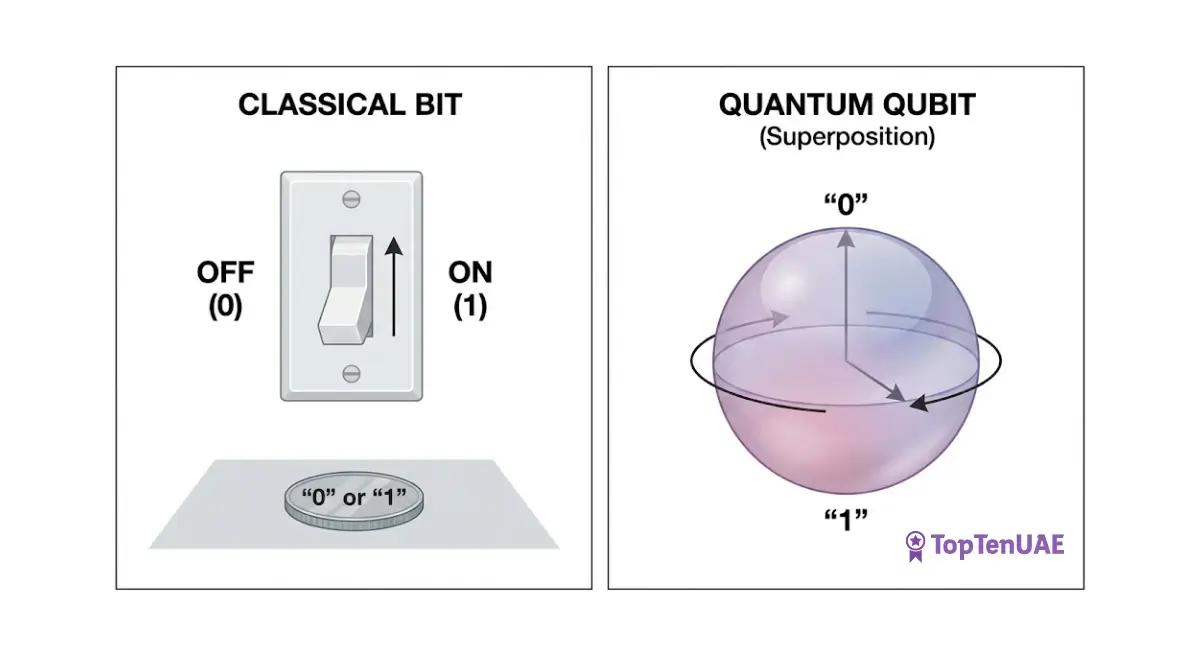
Classical computers process information using bits. A bit is like a tiny switch that can only be in one of two definite states: 0 (off) or 1 (on). Every app, website, and digital photo is built from long strings of these binary codes.
Quantum Computing: Embracing Probability
Quantum computers use quantum bits, or qubits. A qubit is typically a physical system, like a single electron or a superconducting circuit, that obeys the rules of quantum mechanics. This allows it to do something extraordinary: it can exist in a superposition of states.
Think of it like a coin spinning in the air.
- A classical computer sees it as either heads or tails.
- A quantum computer works with the coin while it's still spinning, effectively processing it as both heads and tails simultaneously. In quantum physics, this complex state is often visualized as a sphere, where the qubit can point in any direction, not just up or down.
The Power of Exponentials
The power grows exponentially as you add more qubits. Two classical bits can represent one of four combinations (00, 01, 10, 11) at any one time. Two qubits in superposition can represent all four combinations at once. With just 100 qubits, a quantum computer could theoretically represent more combinations than there are atoms on Earth.
| Feature | Classical Computer | Quantum Computer |
|---|---|---|
| Basic Unit | Bit (0 or 1) | Qubit (0, 1, or superposition) |
| Data Processing | Sequential operations | Parallel operations via superposition |
| Information Scaling | Linear with bits | Exponential with qubits |
| Governing Laws | Classical Physics | Quantum Mechanics |
The Strange Principles That Make It Work
Quantum computing leverages several counterintuitive properties of the quantum world.
1. Superposition: Being in Multiple States at Once
As described, superposition is the ability of a quantum system to be in multiple states simultaneously. A helpful analogy is a person standing on a ladder. In our everyday world, you can only stand on one rung at a time. In the quantum world, a particle can act as if it's on the ladder's lowest and highest rung at the same time.
2. Entanglement: The "Spooky" Connection
Entanglement is a powerful link that can form between qubits. When qubits become entangled, the state of one instantly correlates with the state of the other, no matter how far apart they are. If you measure one entangled qubit and find it's a 0, you'll know its partner is a 1 with 100% certainty. This linkage is crucial for performing complex, multi-qubit operations.
3. Interference: Guiding Toward the Right Answer
Quantum interference is the process of amplifying the probability of correct answers and canceling out wrong ones. Think of waves in the ocean; engineers design algorithms so that "wrong" waves cancel each other out, while "correct" waves reinforce each other.
4. Decoherence: The Biggest Enemy
Decoherence is the loss of quantum information. Qubits are incredibly fragile. A stray photon, vibration, or temperature fluctuation can cause them to collapse into a regular bit state. This is why building a stable quantum computer is currently one of the hardest engineering challenges on the planet.
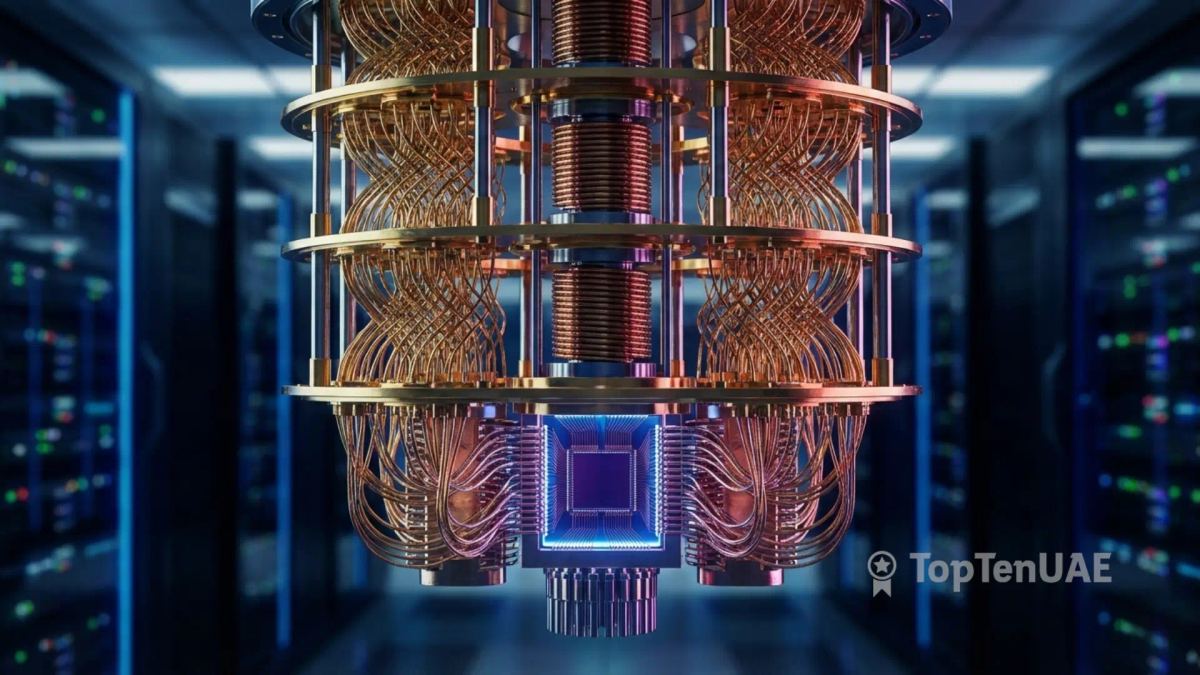
The Physical Machine: A Car-Sized Deep Freeze
A practical quantum computer is a feat of extreme engineering.
- The Quantum Chip: At the heart is the processor, often not much bigger than a standard chip.
- The Deep Freeze: To stop decoherence, chips are housed in dilution refrigerators cooled to -273°C—colder than outer space.
- Control Systems: A complex array of lasers and microwave emitters surrounds the chip to control the qubits.
The "Killer Apps": Where Quantum Will Shine
Quantum computers won't replace your laptop. They will act as specialized accelerators for specific problems:
- Modeling Nature (Pharma & Materials): Simulating complex molecules for drug discovery or designing new materials for better batteries.
- Optimization: Finding the absolute best path in global shipping logistics, financial portfolios, or AI training data.
- Cryptography: This is the double-edged sword. While quantum computers could theoretically break current RSA encryption, the world is moving toward post-quantum cryptography to secure data before that happens.
Current Challenges and the Road Ahead
Despite the excitement, we are in the "NISQ" (Noisy Intermediate-Scale Quantum) era. Key challenges remain:
- Error Rates: Qubits are error-prone.
- Scaling: We need machines with millions of qubits; currently, we are working with hundreds or low thousands.
Conclusion: The UAE Context
The journey from theoretical concept to transformative tool is underway. For businesses and tech enthusiasts in the UAE, this is a critical time.
The UAE has identified quantum technology as a strategic priority. Institutions like the Technology Innovation Institute (TII) in Abu Dhabi have established dedicated quantum research programs (such as the Quantum Research Centre - QRC), focusing on building the region’s first quantum computer and developing quantum-safe cybersecurity.
As physicist John Preskill notes, we must be "realistic about the timescale," but the potential to revolutionize fields like medicine and logistics is undeniable.