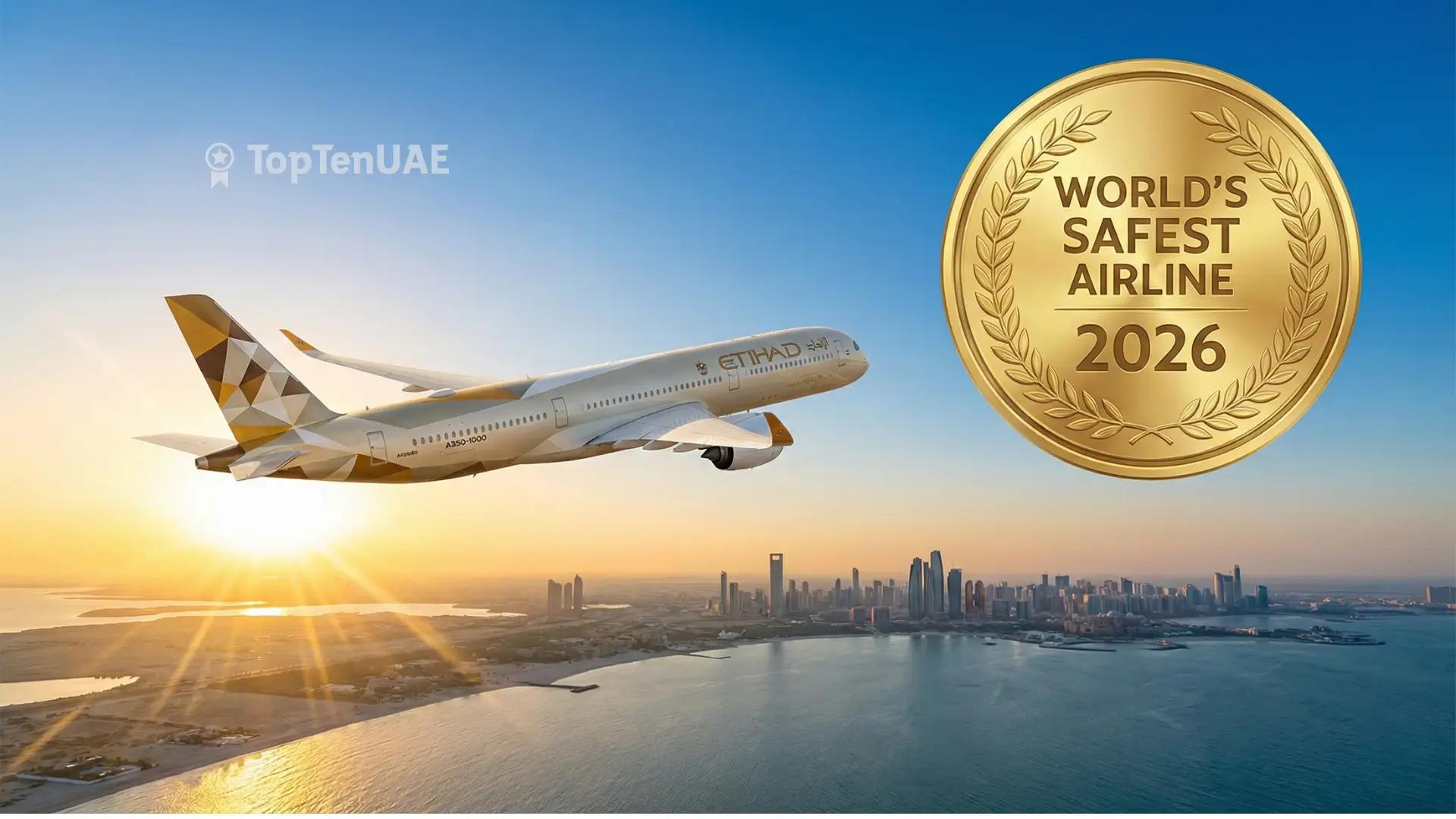
World's Safest Airlines 2026: UAE’s Etihad Takes the Crown

Last Updated:
World's Safest Airlines 2026: UAE’s Etihad Takes the Crown

For travelers in the UAE, safety isn't just a luxury—it is the non-negotiable foundation of every journey. As we navigate the skies in 2026, the question on every passenger's mind is no longer just about legroom or gourmet meals, but about unparalleled peace of mind.

The 2026 global safety rankings are officially out, and they reveal a historic shift. For the first time, Etihad Airways has been crowned the World's Safest Airline, leading a dominant performance by Gulf carriers. With Emirates also securing a top-tier position, the UAE has firmly established itself as the global capital of aviation safety.

Whether you are flying business to New York, taking the family home for school breaks, or embarking on a pilgrimage, this guide ranks the Top 10 Safest Airlines for 2026. We move beyond marketing claims to analyze the hard data: accident records, fleet age, pilot training, and the new "Safety II" protocols that distinguish the exceptional from the merely adequate.


How We Determined the 2026 Rankings

Before revealing the full list, it is vital to understand how safety is measured in 2026. Our rankings are based on a rigorous analysis of five critical factors:

  • Accident & Incident History: A review of at least 10 years of crash-free records.
  • Fleet Modernization: Airlines with younger aircraft (like the A350 and 787) feature advanced automated safety systems.
  • Operational Excellence: Compliance with strict international audits, including the IATA Operational Safety Audit (IOSA).
  • Pilot Training: The quality of flight simulators and crew resource management.
  • COVID-19 & Health Protocols: Post-pandemic adaptation and cabin air quality standards.

The World's Safest Airlines for 2026 (Ranked)

Our Top Recommendations

#1

Etihad Airways

United Arab Emirates
Safest Airline 2026
Etihad Airways

Editor's Verdict

Officially crowned #1 for 2026. Etihad secured the top spot with its flawless operational history, "Safety II" proactive risk management, and massive investment in pilot training.

IATA
EY
Home Base
United Arab Emirates
Safety Score
7/7
Visit Official Website
#2

Qantas

Australia
Industry Legend
Qantas

Editor's Verdict

The industry benchmark. Qantas holds an unmatched 100-year fatality-free record in the jet era and remains the gold standard for long-haul safety.

IATA
QF
Home Base
Australia
Safety Score
7/7
Visit Official Website
#3

Emirates

United Arab Emirates
Home Sky Champion
Emirates

Editor's Verdict

A massive win for Dubai. Emirates ranks in the Top 3 thanks to operating one of the world's youngest wide-body fleets (A380s & B777s) and rigorous maintenance standards.

IATA
EK
Home Base
United Arab Emirates
Safety Score
7/7
Visit Official Website
#4

Qatar Airways

Qatar
7-Star Safety
Qatar Airways

Editor's Verdict

Consistently excellent. Qatar Airways combines luxury with rigorous oversight and centralized hub maintenance, ensuring safety standards few can match.

IATA
QR
Home Base
Qatar
Safety Score
7/7
Visit Official Website
#5

Singapore Airlines

Singapore
Asian Excellence
Singapore Airlines

Editor's Verdict

Renowned for meticulous engineering. Singapore Airlines is the preferred choice for connecting to Asia, utilizing next-gen navigation tech for long-haul flights.

IATA
SQ
Home Base
Singapore
Safety Score
7/7
Visit Official Website
#6

Air New Zealand

New Zealand
Weather Masters
Air New Zealand

Editor's Verdict

Masters of difficult terrain. Their pilots are specifically trained to handle severe weather and challenging approaches, making them one of the most resilient crews globally.

IATA
NZ
Home Base
New Zealand
Safety Score
7/7
Visit Official Website
#7

Cathay Pacific

Hong Kong
Uncompromising
Cathay Pacific

Editor's Verdict

A strong return to the top tier. Cathay maintains a "zero-tolerance" policy for technical errors and adheres to Hong Kong’s rigorous aviation safety regulations.

IATA
CX
Home Base
Hong Kong
Safety Score
7/7
Visit Official Website
#8

All Nippon Airways (ANA)

Japan
Japanese Precision
All Nippon Airways (ANA)

Editor's Verdict

Famous for obsessive attention to detail. From maintenance to cabin protocols, ANA’s disciplined culture ensures an operation that is virtually error-free.

IATA
NH
Home Base
Japan
Safety Score
7/7
Visit Official Website
#9

Lufthansa

Germany
Engineering Giants
Lufthansa

Editor's Verdict

Europe’s safety leader. They own 'Lufthansa Technik', which services half the world's airlines, ensuring their own fleet is maintained by the absolute masters of the trade.

IATA
LH
Home Base
Germany
Safety Score
7/7
Visit Official Website
#10

Virgin Australia

Australia
The Safe Challenger
Virgin Australia

Editor's Verdict

A perfect safety record in the jet era. Virgin Australia proves you don't need to be a government giant to prioritize passenger safety, rounding out our 2026 list.

IATA
VA
Home Base
Australia
Safety Score
7/7
Visit Official Website

Traveler's Guide & Tips

Expert Safety Tips for Your Next Flight

Even when flying the world's safest airlines, you can enhance your own security:

  1. Check the Aircraft: When booking, look for newer models like the A350 or B787 Dreamliner, which have advanced turbulence-dampening tech.
  2. Count the Rows: Always count the rows to the nearest emergency exit (front and back). In an emergency, visibility might be low, and "counting" is more reliable than "looking."
  3. Listen to the Briefing: Aircraft configurations vary. Even frequent flyers should watch the safety demo to know exactly how this specific plane’s doors open.

Frequently Asked Questions

Which is the safest airline in the world in 2026?

Etihad Airways (UAE) has been named the World's Safest Airline for 2026, followed closely by Qantas and Emirates.

Is Emirates airline safe to fly?

Yes, absolutely. Emirates is ranked #3 globally for safety in 2026. It operates one of the world's youngest fleets and has a dedicated flight training academy in Dubai.

How are airline safety rankings calculated?

Rankings are based on crash records (over 10 years), fleet age, pilot training standards, and audits from government bodies like IATA and ICAO.