
Describe your goal before choosing millimetres
Write down three things: the finish you want, the areas you maintain and whether you prefer one consistent length or several graduated lengths.
A beard-only routine needs different equipment from a combined beard, head-hair and body routine. A buyer who changes length frequently may value adjustment differently from someone who keeps the same setting every week.
Rather than treating a photograph as a precise millimetre measurement, use the manufacturer's documented settings as a starting point and the exact grooming instructions to establish a suitable routine.
What millimetre setting should you start investigating?
The following are broad appearance conventions, retained from this site's existing length guide—not guarantees about how an individual beard will look.T2
| Starting description | Approximate nominal range | Buying implication |
|---|---|---|
| Very short stubble | 0.5–1 mm | Verify whether the quoted minimum uses a guard or the bare cutter |
| Defined stubble | 1–3 mm | Check the actual short-length adjustment steps |
| Short beard | 3–5 mm | Fixed settings may be enough when one matches your preference |
| Medium beard | 6–10 mm | Check the appropriate beard comb rather than just the overall maximum |
| Longer beard | About 10 mm and above | Verify the supported beard attachment and usable length range |
These categories overlap. Hair colour, density, curl, growth direction and technique affect appearance. A nominal setting is a product-control reference, not an exact prediction of the final visual result.T2
Range, increments and attachments are not interchangeable
| Specification | The question it answers | The question still to ask |
|---|---|---|
| Overall range | What endpoints does the kit advertise? | Which attachment creates each usable length? |
| Adjustment increment | How far apart are adjacent supported settings? | Does that increment apply throughout the range? |
| Comb length | What nominal length is assigned to this guard? | Is it designed for beard, head hair or another task? |
| Attachment count | How many included components are being counted? | How many will you actually use? |
Use this as a checklist against the exact kit rather than a specification ranking.
Fixed combs versus adjustable combs
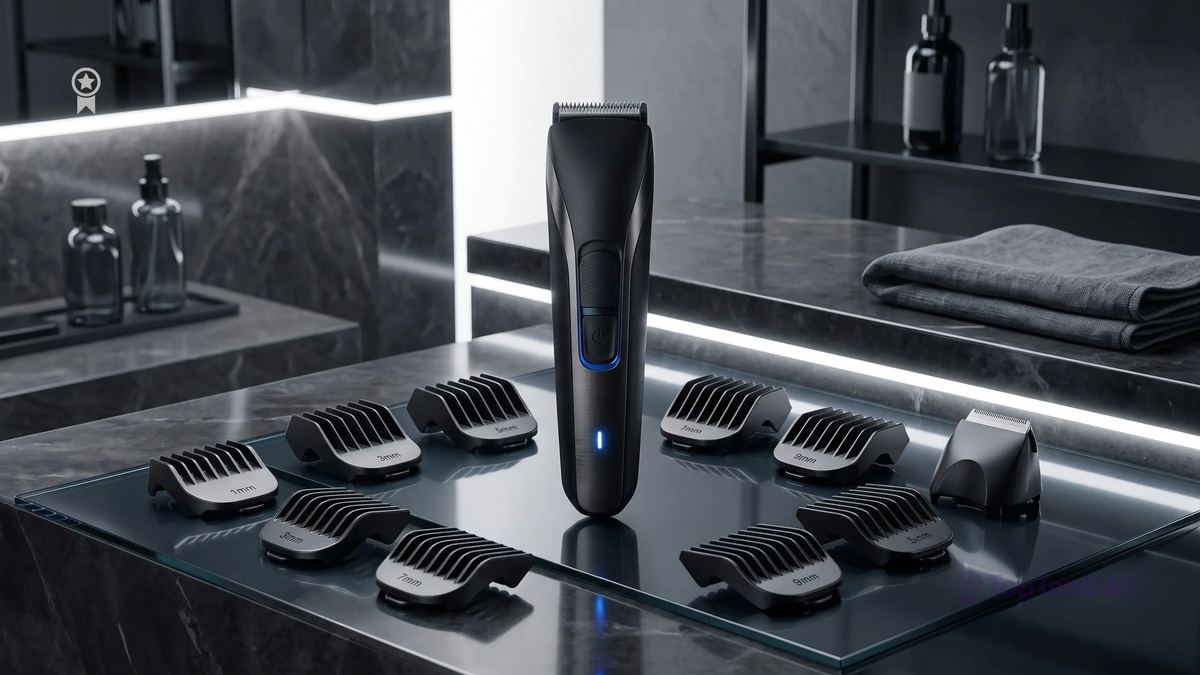
A fixed comb can be the sensible choice when it matches your normal length. There is no benefit in purchasing more adjustment than you use. The questions are whether the right guards are supplied and whether replacements are identifiable.
An adjustable comb becomes useful when your preferred setting falls between the fixed options or you change length regularly. Check how the setting is selected and secured. Do not infer adjustment stability from a product photograph or a large setting count alone.
Our editorial preference is to start from the required lengths and work outward. This avoids paying for a much broader system to solve a simple task—or discovering that a basic kit cannot produce your preferred setting.
Example: the Philips precision-comb distinction
For MG7922/15, Philips identifies an adjustable precision comb covering 1–3 mm in 0.2 mm steps. MG3920/15 lists fixed stubble, beard and hair combs instead.P1(opens in a new tab)P2(opens in a new tab)
That creates a meaningful buying question. Someone choosing between close short-beard settings has a reason to investigate the precision comb. Someone satisfied with one supplied fixed setting may not need it.
The phrase 0.2 mm precision must not be stretched into a claim that the entire MG7922 kit adjusts in those increments. Read the comb-specific specification. The MG7922/15 vs MG3920/15 comparison also covers the differences beyond length control.
A large maximum does not settle the long-beard decision
Check whether the longest guard is intended for the beard or for head hair. Then examine the operating instructions rather than assuming the maximum number promises an effortless result.
Philips' grooming guidance notes that not every beard trimmer is optimised for very long beards, and it stresses using the appropriate attachment for the area.P8(opens in a new tab)
Our judgement: a well-matched attachment is more important than the longest figure in a comparison table. The same principle applies to edging—having a long guard tells you little about how conveniently you can work around a moustache.
Know what each additional tool contributes
A useful kit should make its tasks clear. Separate the main trimming head from a detail attachment, nose/ear tool and any manufacturer-designated body equipment.
Do not count a storage pouch or cable as an extra grooming capability. Conversely, do not dismiss a modest kit when its small set contains everything you need.
For a haircut decision, use beard trimmer vs hair clipper. For a body-focused purchase, use beard trimmer vs body groomer. Those guides address a different question from choosing beard-length settings.
Avoid blaming the setting before checking the setup
Philips' troubleshooting advice highlights attachment seating, excessive pressure, growth direction and wet hair as possible contributors to uneven trimming.P8(opens in a new tab) Follow the instructions for your exact model rather than treating more passes or more force as the automatic answer.
This does not mean every uneven result is user error. A damaged or unsuitable appliance may require support. It does mean that a new purchase should solve an identified limitation, not merely offer more settings on its box.
We have not tested the comfort, pulling or cutting consistency of the models discussed here.
Turn the information into a purchase checklist
Before buying in the UAE, record the full model suffix and the exact included guard set. Check that the product description and selected marketplace variant agree.
Then consider storage and replacement. For a small apartment bathroom, a pouch holding the guards you actually use may be more practical than a larger assortment with no clear place to keep it. Before relying on a replaceable guard or blade, check that you can identify the part and a suitable source.
Finally, compare the charging routine. The correct comb is still inconvenient if the appliance is empty when you need it. Our beard-trimmer charging guide explains how to compare that separately.
Which model should you examine next?
For a combined grooming kit with a short-length precision comb, read the MG7922/15 review. For a simpler fixed-comb approach, read the MG3920/15 review.
For other control systems and finishing approaches, return to the full beard-trimmer shortlist. These are routes to compare, not a claim that any model or offer suits every buyer.